Which SAG Is Right for You (tables alone won't tell you)

You've measured. The notebook says forty-four millimetres at the rear.
Now what?
Forty-four means nothing on its own. On my Tracer, which has a hundred and forty-two millimetres of rear wheel travel, that's thirty-one percent — right in the zone. The same reading on a supersport bike would mean a rear end sitting like a sofa. On a two-hundred-and-forty-millimetre big adventure bike it would be as stiff as a table.
SAG only makes sense as a percentage of travel. It's the only way to compare different motorcycles, and it's exactly why the millimetre tables that circulate in forums and groups are, at best, useless.
If you haven't taken your measurements yet, start with the article How to Measure SAG.
First you need a number from the spec sheet
Travel is the suspension's full stroke. It's in the technical specifications, in the chassis section of the manual, listed as "front wheel travel" and "rear wheel travel".
Watch out for something that trips a lot of people up: wheel travel is not the same as shock stroke. At the rear, there's a linkage in between, which multiplies the shock's movement into wheel movement at a ratio that changes from bike to bike. The percentages below refer to wheel travel, which is what manufacturers actually publish.
The maths is a simple division. Forty-four divided by a hundred and forty-two is 0.31. Thirty-one percent.
The numbers
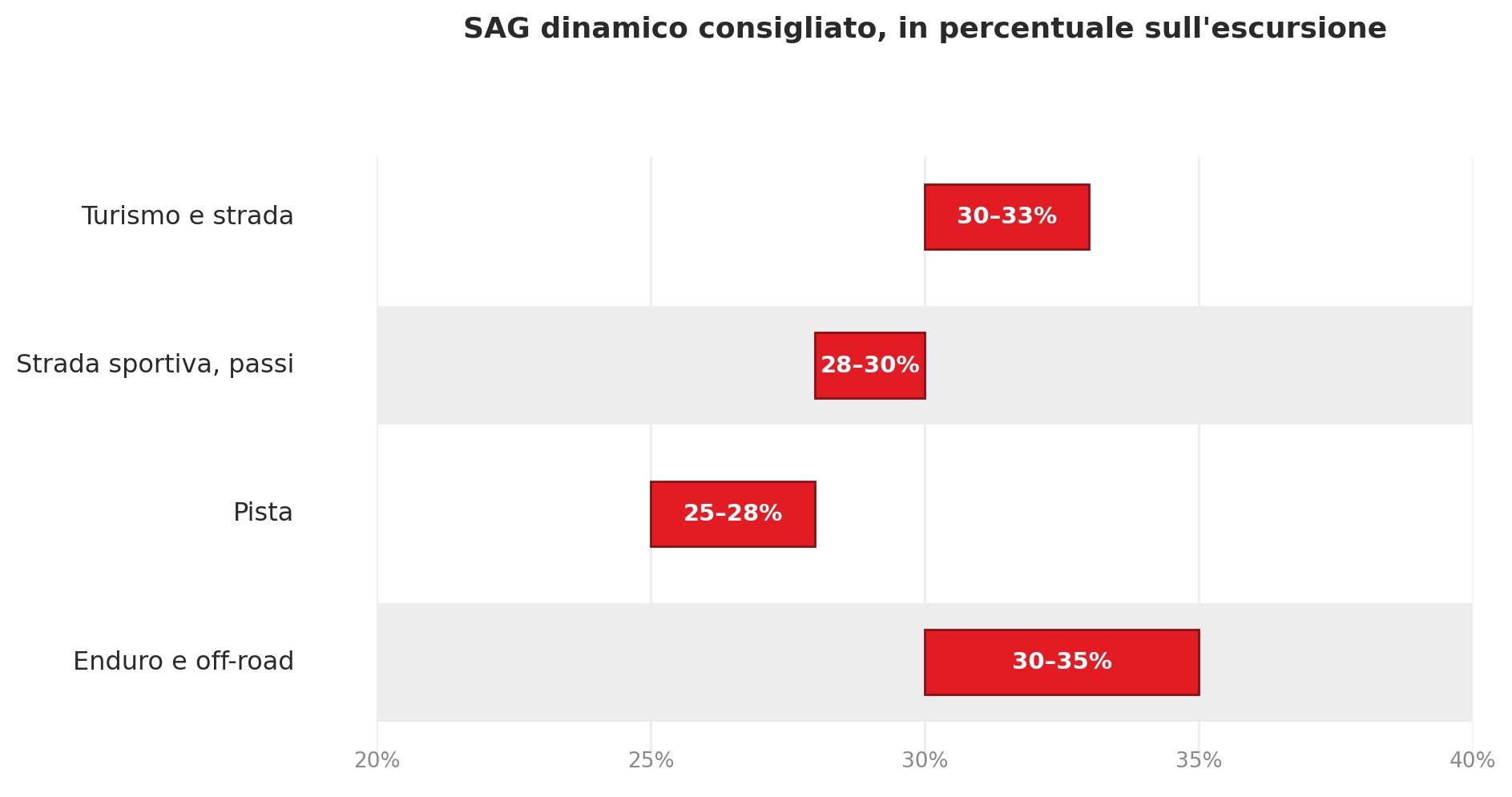
- Touring and road. Thirty to thirty-three percent, front and rear. You want comfort, and you want the bike settled over four hundred kilometres of B-road, even when the tarmac is poor.
- Sporty road riding, mountain passes. Twenty-eight to thirty, front and rear. The bike turns in more readily, but not so stiff that it becomes harsh: passes have their share of bumps, and a bike that doesn't absorb them will tire you out in half an hour.
- Track. Twenty-five to twenty-eight front, twenty-five to thirty rear. Smooth tarmac calls for support under load more than the ability to follow rough terrain.
- Enduro and off-road. Thirty to thirty-five front, thirty-three to thirty-five rear. Here the suspension needs plenty of downward travel to follow terrain that does whatever it wants.
- With a passenger or luggage. There isn't a different percentage target. What changes is that the extra weight shifts your SAG, and you need to add rear preload to bring it back into your usual range.

Now, the part the tables don't tell you
Those numbers get you into the right zone. They are not a target to hit exactly.
Two people of the same weight, on the same bike, on the same road, can feel perfectly at home at different percentages, because they ride differently. One brakes late and hard, the other carries corner speed smoothly. There is no single correct number in the abstract: there's the one where the bike does what you expect it to.
If you're at thirty-one percent and it feels right, don't drop to twenty-nine just because a table says mountain passes want that. I say this because I did exactly that, and spent two rides wondering why the bike had gotten worse than before.
The real point of the table is different. If you're at forty-two percent, you're out of zone in a way that no riding style can justify. That's where something genuinely needs fixing, and the table just told you so.
Front and rear aren't two separate problems
This one took a while to sink in for me.
If you raise only the rear, you're not "adjusting the rear": you're changing the rake of the entire motorcycle. It turns in faster and, at the same time, gets twitchier at speed. Raise the front and the opposite happens — calmer, but lazier to drop into a corner.
Hence the practical rule: move one end at a time, and once you're done, recheck both SAG figures. It happens very often that you fix the rear and find the front out of range without ever having touched it, simply because the weight distribution has changed.
The passenger case almost nobody deals with
This is the situation where the largest number of people ride around with the wrong setup, without realising it.
Add a passenger and luggage, and the load on the rear can climb by forty to fifty percent. A SAG that was thirty-two percent unladen can easily jump past forty-five. The suspension starts out already compressed, the usable compression stroke shrinks, and the first serious bump taken two-up bottoms out. On top of that, the bike squats at the rear, the front gets light, and the steering turns vague right when you have an extra ninety kilos to manage.
The preload knob many touring bikes have under the seat isn't a convenience feature. It's exactly the adjustment you need every time your load changes, and it's meant to be used.
On electronic suspension, the menu does the work, but the principle doesn't change, and SAG remains just as measurable.
And if you're out of range?
Depends on by how much.
If turning the collar gets you there, it's a preload matter: covered in the article Preload Doesn't Make the Spring Stiffer.
If getting there means winding it almost all the way in, or all the way out, preload has run out of margin and it's a different conversation. That's the article When the Spring Is No Longer the Right One.
If you'd rather skip the calculator altogether, ClickGarage.AI takes your measurements, your bike's travel, and your riding style, and gives you the deviation and the correction in clicks directly. Your first one is free.
Run the numbers on your own bike
ClickGarage.AI works these values out from your bike's data and your real weight. Go to the calculator