When the Spring Is No Longer the Right One

The suspension fitted to your bike was sized for a rider who doesn't exist. He weighs around seventy-five kilos, never carries luggage, never has a passenger, and rides in an average sort of way.
If you happen to resemble that rider, you're lucky. If you weigh sixty or ninety kilos, or if you always ride loaded, no amount of adjustment will ever get you truly where you want to be: you can turn adjusters for months and still be stuck halfway there.
Recognising this quickly is the difference between a well-spent afternoon and an entire season of guesswork.
The three signs
Preload is at the end of its travel. If getting SAG into range means winding the collar in almost all the way, the spring is too soft for you. If you have to back it all the way out and SAG is still low, it's too stiff. Either way, you've run out of margin, and pushing further in that direction won't achieve anything more.
Static and dynamic don't agree. If static SAG is fine but dynamic is very high, the spring is right for the bike but not for you: it holds up the bike's own weight, not yours on top of it. This is the classic case for anyone who's on the heavier side, or who always travels with panniers.
The bike never finds a compromise. SAG is correct, and yet it's still harsh over small bumps and still bottoms out on the big ones. You're asking that spring for two behaviours it simply can't deliver together at that particular K.
The zip tie
Now let me show you the best diagnostic tool you have, and it costs about five cents.
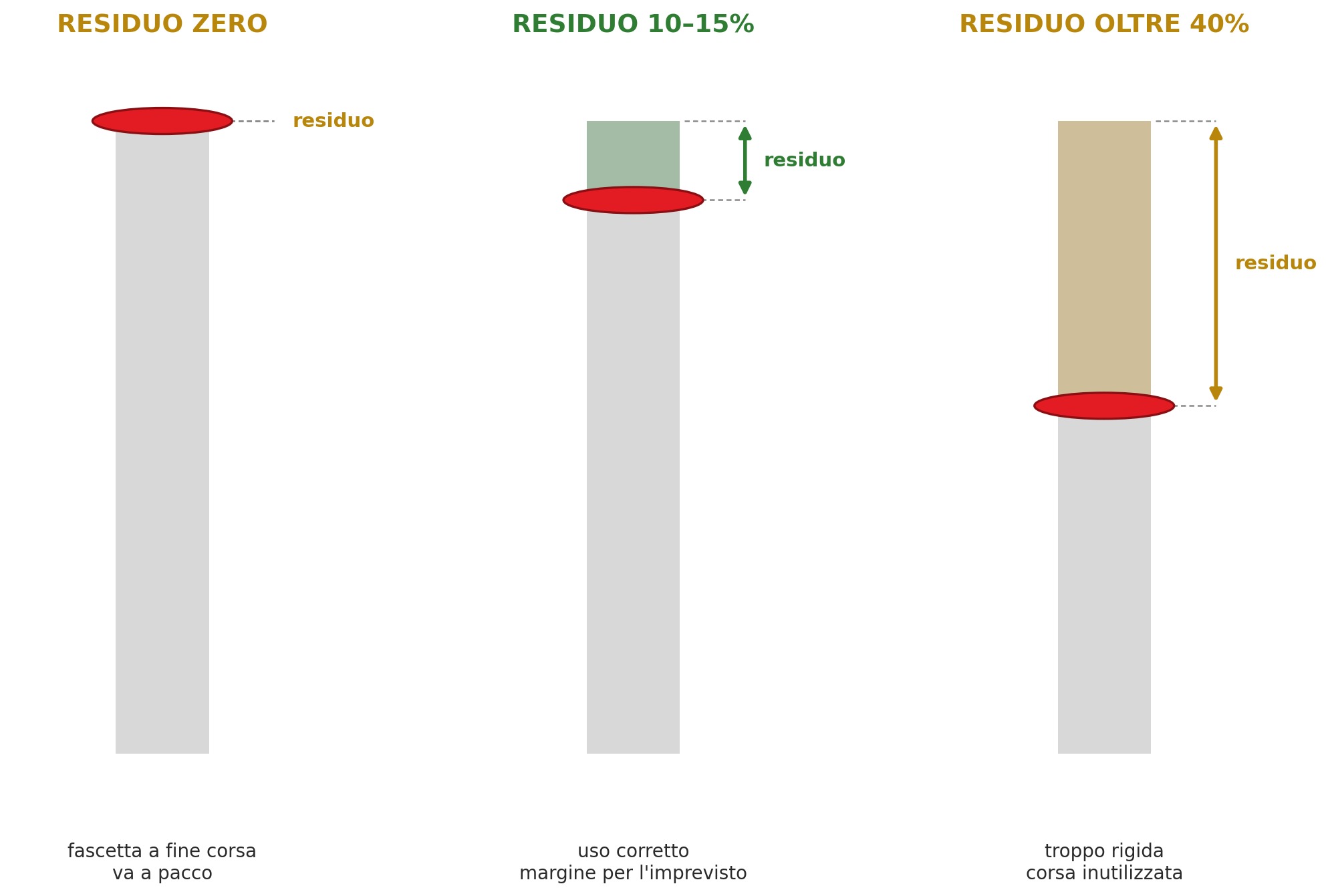
Take an electrician's zip tie, slide it onto the fork stanchion, and push it down until it rests against the dust seal. Tighten it just enough that it won't slide on its own, but not so much that it can't move at all.
As the suspension compresses, the dust seal pushes the zip tie up the stanchion, and the tie stays put at the furthest point reached. It's a maximum-reading indicator, like an old mercury thermometer: it doesn't tell you what happens moment to moment, it tells you how far you got.
On upside-down forks, which are the majority these days, the slider is at the top and the zip tie gets pushed downward, toward the wheel. On a conventional fork it's the opposite, and the tie moves up. Either way, the same rule applies: the residual is the exposed stanchion left beyond the tie.
Then go ride. About twenty kilometres on the kind of road you normally ride, riding the way you normally would. No deliberate hard braking just to move the tie — that would only falsify the result by measuring a riding style that isn't yours.
When you get back, measure how much stanchion is left exposed beyond the tie.
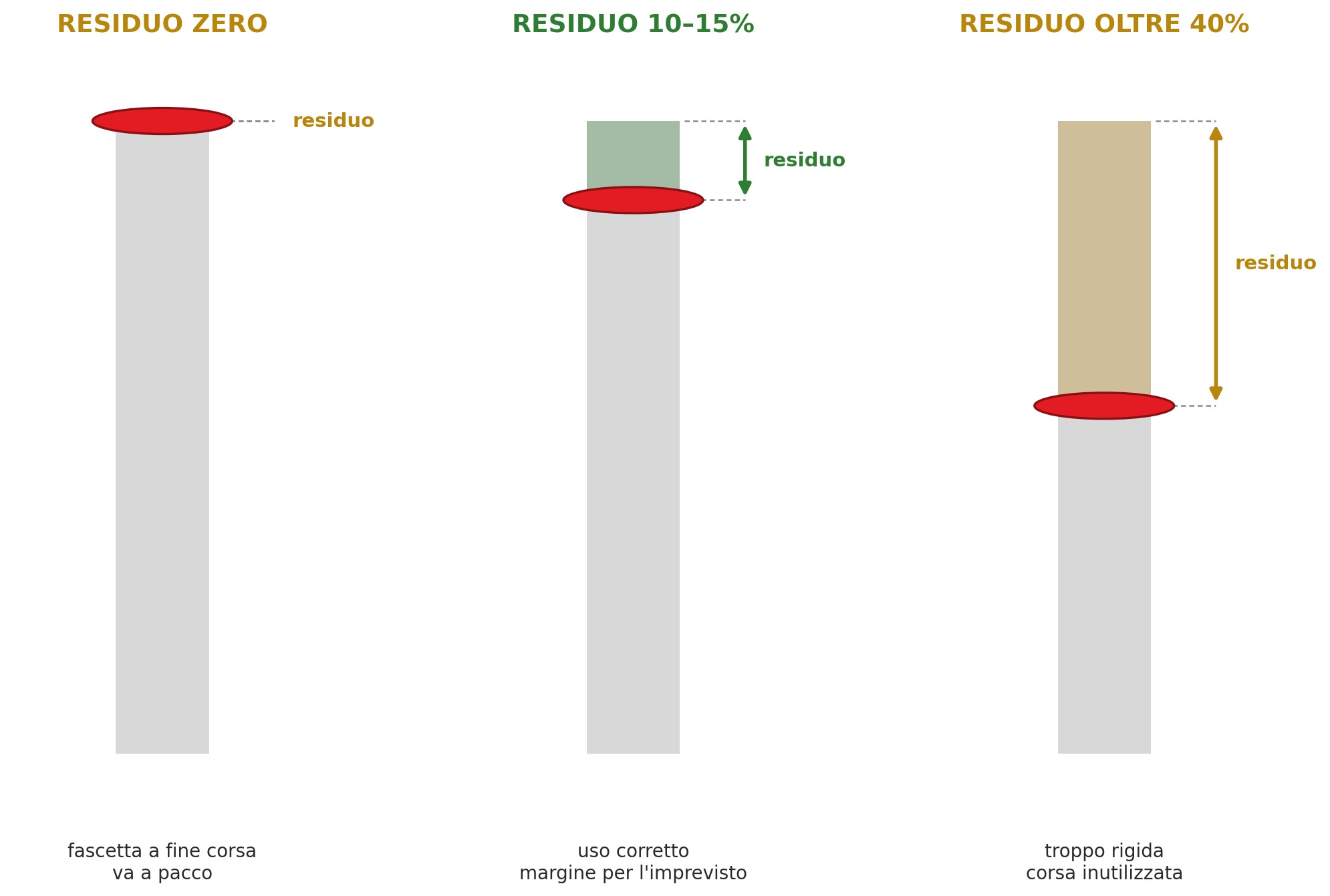

- Residual of roughly ten to fifteen percent. You're using the suspension well. You have margin for the unexpected and you're not wasting travel.
- Zero residual, the tie has reached the bottom. You're bottoming out. You need more preload or more compression damping, and if neither is enough, a stiffer spring.
- Residual over forty percent. The suspension is too stiff for how you ride. You're carrying around nearly half the travel that you never touch, and meanwhile the tyre is copying the road surface worse than it could.
The same method works on the shock, wherever the shaft is accessible — on many bikes that means removing a side panel.
You don't need a spring dyno to know whether a spring suits you. The zip tie gives you the same information on the road, on your own bike, with you on it and the load you actually carry. In other words, under the only conditions that matter. And it's the right method for anyone who isn't a mechanic: no tools required, nothing to open up, and no way to get it wrong that's remotely dangerous.
Before you order anything: is the suspension still healthy?
This question has to come before everything else, because the symptoms look remarkably similar.
Suspension has a service interval, specified by the manufacturer, that almost nobody respects. Oil degrades, seals lose their elasticity, and hydraulic damping stops doing its job long before you ever see anything weeping from the stanchions.
A fork that feels too soft after sixty thousand kilometres, nine times out of ten, doesn't have the wrong spring: it has spent oil. Buying new springs in that case is spending money without fixing anything — and fitting them onto damping that no longer damps.
The signs to check before concluding anything: a film of oil on the stanchions, movement that feels hollow in the first few millimetres, and above all behaviour that has worsened over time rather than always having been that way. If the bike has changed, it isn't the spring — springs don't fatigue in a year.
What changing K actually means
K is stiffness, in newtons per millimetre. A 9.5 N/mm spring requires 9.5 newtons to compress by one millimetre, and it always requires exactly that, whether it's already compressed or not.
Changing springs means moving to a different K, calculated for your riding weight and how you use the bike. It isn't something to do by copying what someone else fitted, as seen on a forum: two riders of the same weight on different motorcycles need different K values, because leverage ratio, travel, and weight distribution all change.
Four things worth knowing before you spend the money:
- Front and rear are evaluated together. Changing only the shock spring on a bike whose fork is also undersized just moves the problem forward. Literally.
- This isn't routine maintenance. Working on the shock spring means removing the shock and having the equipment to compress the spring safely. It's workshop work, and that's fine.
- A new spring resets the whole setup. SAG, preload, damping: all need redoing, in that order. The clicks you'd found before are worth nothing anymore.
- A new spring won't fix a tired shock. See the paragraph above.
How the number is actually calculated
The calculation combines your riding weight, the suspension's travel, the target SAG for your riding style, and, at the rear, the bike's leverage ratio. It isn't complicated in itself, but it wants precise inputs and doesn't forgive rough estimates: leverage ratio enters the equation squared, so a ten percent measurement error becomes more than twenty percent in the result.
If you have the measurements, ClickGarage.AI tells you whether the stock spring suits you and what K you'd actually need, calculated for your specific bike and your weight, instead of handing you a generic formula to work out by hand.
And if this is the first article you've landed on, start with How to Measure SAG.
Run the numbers on your own bike
ClickGarage.AI works these values out from your bike's data and your real weight. Go to the calculator