Suspension Travel and Chassis Geometry: Your Bike's Numbers

Before talking about clicks, preload, or SAG, there's a number that comes before all the others: how far your suspension actually moves. Without it, every other calculation starts on the wrong foot.
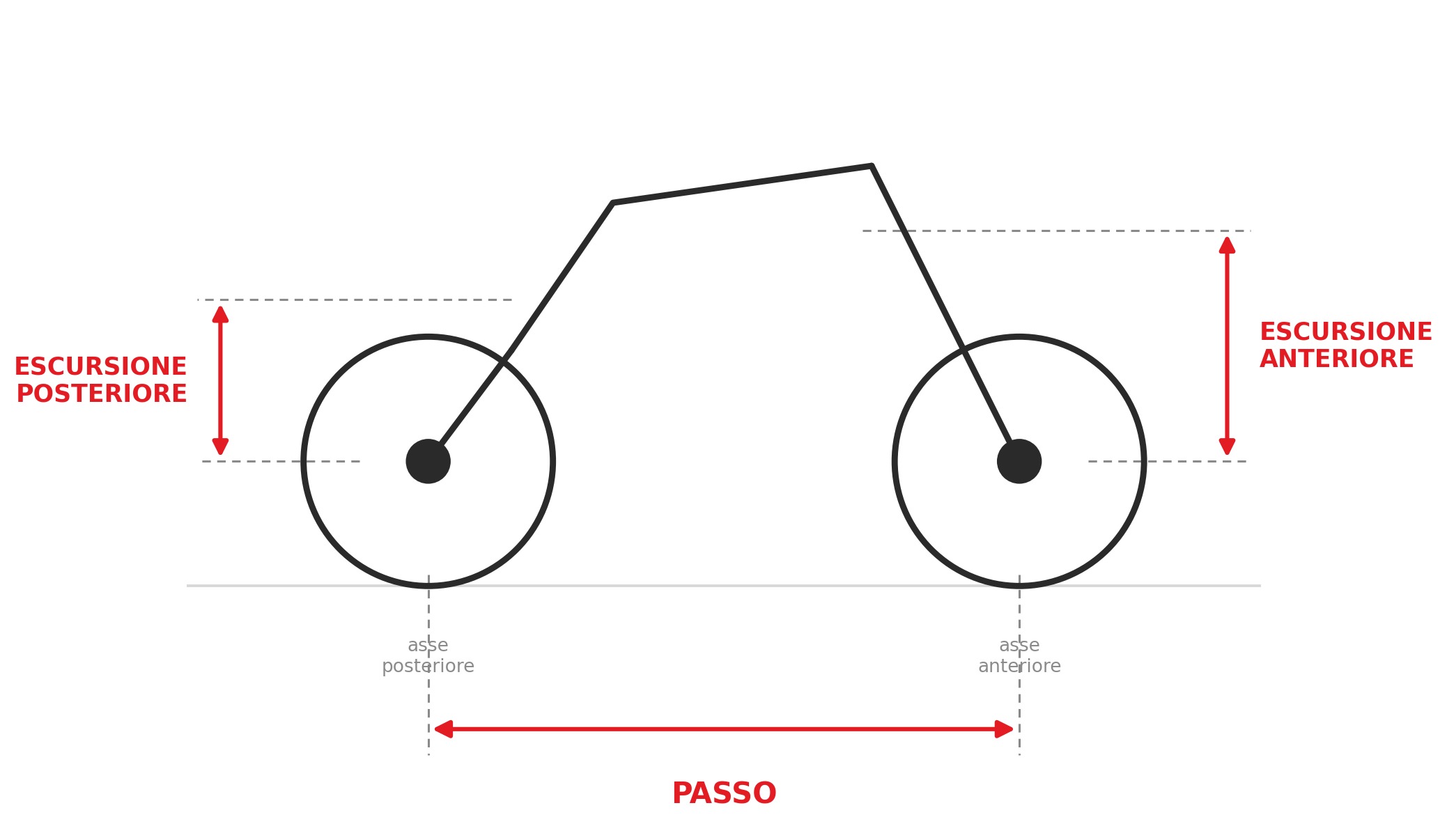
What these numbers are
Travel is the total distance the wheel can move, from fully extended to fully compressed. Front and rear are almost always different, and there's nothing odd about that: they're two different mechanical systems, with different leverage ratios.
Wheelbase is the distance between the two axles, front and rear. It matters because it determines how much weight ends up on one suspension or the other depending on how it's distributed on the bike — a full top box or a passenger shifts the centre of gravity differently on a short wheelbase than on a long one.

Where to find them (and where NOT to look)
This is where most people waste time looking in the wrong place: the owner's manual. The manual almost always lists wheelbase and weight, but almost never suspension travel. That number needs to come from the manufacturer's website, the technical spec sheet, or an official brochure for the model.
Two traps, both real, both capable of throwing off the calculation even when starting from an official source:
- Laden wheelbase is not the same as nominal wheelbase. Some spec sheets report the former, measured with the bike loaded, which is slightly different from the latter.
- Dry weight is not the same as kerb weight (weight ready to ride). The first excludes fluids (fuel, oil), the second includes them. The difference can be several kilos, and anyone who overlooks it starts the load calculation already wrong.
The simplest rule: never trust a single source. The manufacturer's site first, a second listing (a dealer database or similar) as confirmation. And never ask a generic chatbot for these numbers: it returns plausible-sounding values, not verified ones — exactly the kind of error that only surfaces once the target SAG refuses to add up with anything.
When travel is short, precision matters more
On motorcycles with very short travel — a cruiser, certain low-slung naked bikes — an error of a few millimetres in the measurement carries proportionally more weight than on a road-enduro with 150mm of travel. On a suspension with 40-50mm of rear travel, a 5mm measurement error is a ten percent mistake; on the same bike with 150mm of travel, the same absolute error is worth a third of that. That's not a reason to skip the calculation — it's a reason to measure twice before trusting the number.
Why it matters more if you ride mountain passes
On a flat stretch of road, the suspension works lightly and consistently. On a mountain pass with tight hairpins and an uneven surface — think of a descent like the Fedaia or the Giau, constant gradient changes, potholes, hairpins in quick succession — the suspension works hard, often close to the extremes of its travel. On that kind of road, starting from a wrong travel figure is felt far more than it would be on a motorway straight.
The right number, in short, isn't a technicality for specialists: it's the foundation everything else in the calculation stands on.
Run the numbers on your own bike
ClickGarage.AI works these values out from your bike's data and your real weight. Go to the calculator