Setting Up the Bike for a Passenger's Weight

Many riders think of a passenger as extra weight to compensate for in a general way — a bit more preload all round and off you go. That's not how it works: a passenger's weight lands mostly on the rear end, and that's where it needs correcting first.
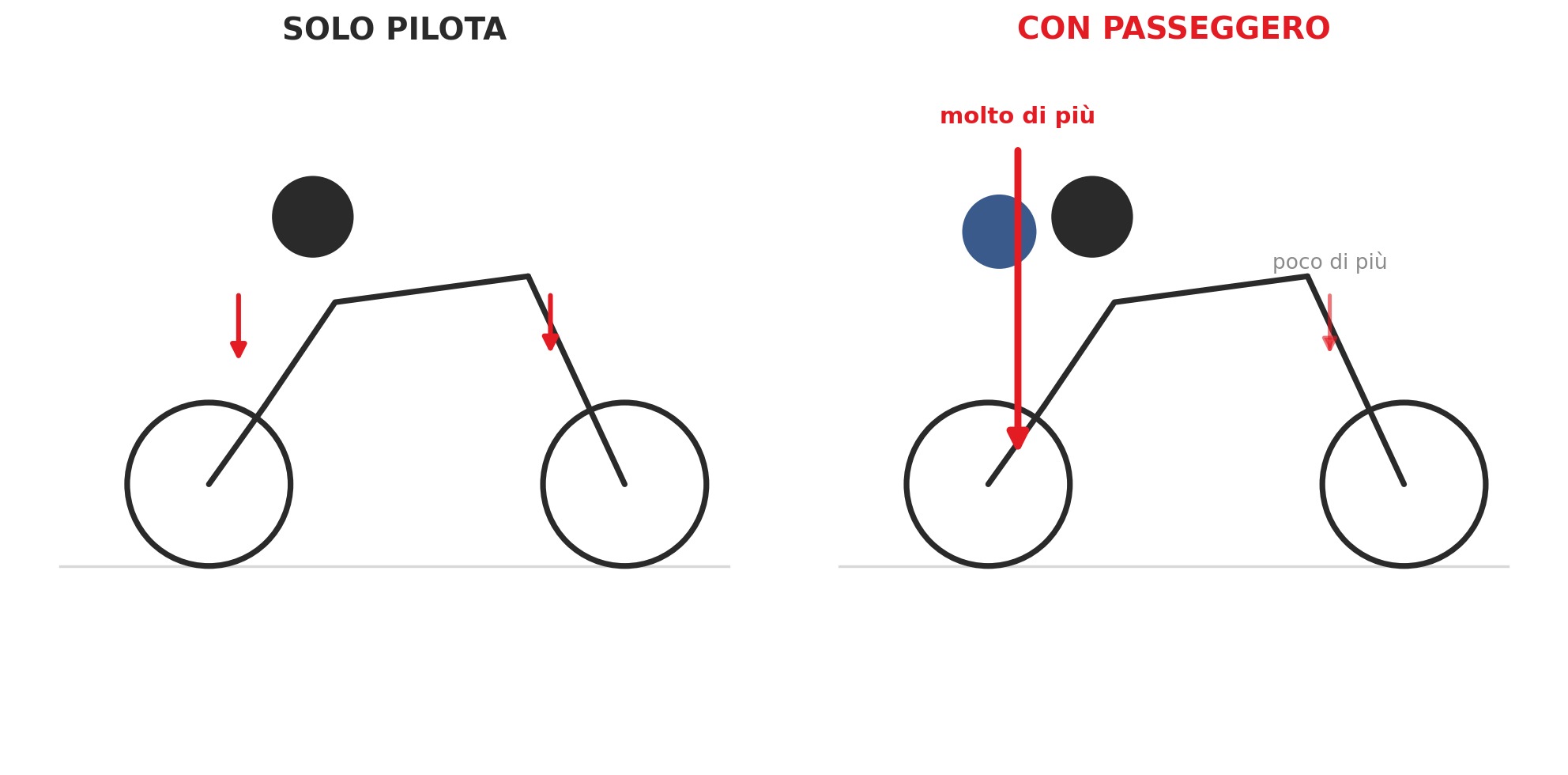
Where the weight actually goes
The passenger sits behind the bike's centre of gravity, so their weight bears down far more on the rear suspension than on the front — the front does feel it, but in much smaller proportion. Adjusting preload and SAG equally on both ends, as if the load were split down the middle, is the most common mistake among those who set up by feel rather than by calculation.
!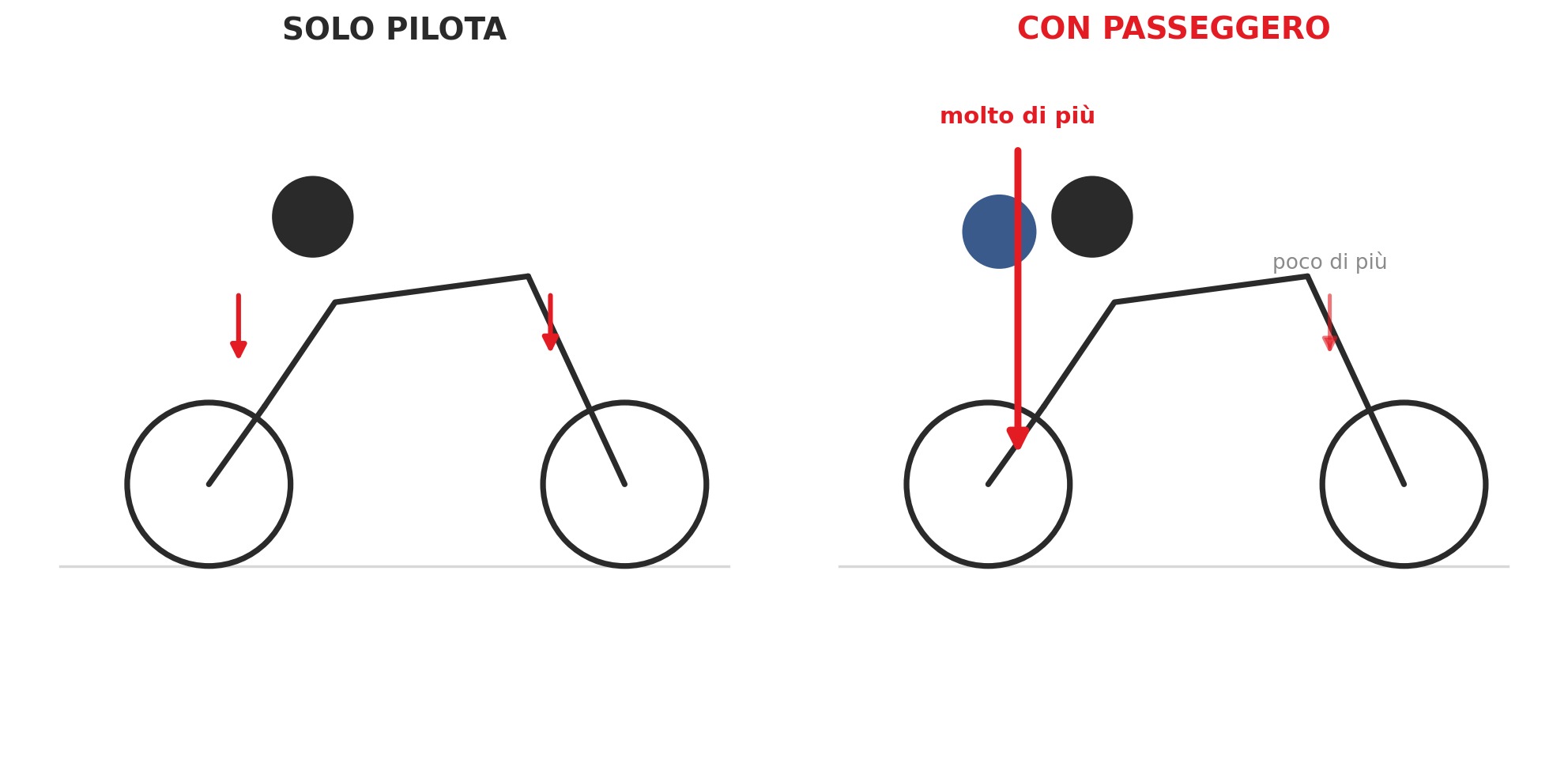 [How load distributes, with and without a passenger](/immagini/carico-passeggero-schema.jpg)
What changes in practice
With a passenger on board, the rear sinks further: if you don't correct preload, rear SAG ends up well past target, the bike sits lower at the back, and the geometry shifts in a way that's felt mainly under acceleration and over rough surfaces — a shock that was well set up solo starts "touching down" more often at the end of its stroke.
Preload isn't always enough
Up to a point, adding preload brings SAG back to target even with a passenger aboard — and that's exactly what it's supposed to do, by definition: preload exists to match the spring to the load, not to change its stiffness. But preload has a physical limit, its own adjustment range: if the passenger and luggage together push the load past that limit, adding more preload no longer achieves anything, because the collar is already at the end of its travel. At that point the fix isn't turning it further, it's a stiffer spring — another signal, alongside the ones covered in the article on spring rate K, that it's genuinely time to change it.
A useful habit
If you only carry a passenger occasionally, it's worth writing down both preload settings — solo and two-up — once you've found them. Getting back to the right value in two minutes before setting off beats adjusting by feel every time, or worse, not adjusting at all and riding around with a setup meant for a different load than the one you're actually carrying that day.
Run the numbers on your own bike
ClickGarage.AI works these values out from your bike's data and your real weight. Go to the calculator